All Saints' Flood of 1570
Hans Brinker, or The Silver SkatesThe All Saints' Flood of 1570 was a catastrophe in which the defenses holding back the sea failed on a vast scale, exposing how closely life in Holland depended on maintained dikes and collective labor. In the book's account, the flood is both a historical calamity and an explanation of the continuing struggle to keep the low-lying country habitable: water is not merely scenery, but a force that demands engineering, vigilance, and public responsibility.
Causes and Vulnerable Defenses
Much of Holland lay below sea level, protected from the ocean by dikes built at great cost. A prolonged, violent gale drove Atlantic waters into the North Sea and pressed them against the Dutch coast. Under that pressure, dikes broke in many places. Even the Hand-bos, a formidable bulwark made of oaken piles, braced with iron, anchored, and reinforced with gravel and granite, was broken apart. Fishing boats and larger vessels were swept inland, where they became entangled among trees or struck buildings.
The inundation came after twenty-eight earlier floods had already overwhelmed parts of Holland. The narrator places the 1570 disaster against this longer history of exposure, and also notes that the country was enduring Spanish tyranny. The flood therefore compounded an existing political hardship with a physical emergency: the same land that had to resist foreign rule also had to withstand water capable of undoing its defenses.
The Flood and Its Human Toll
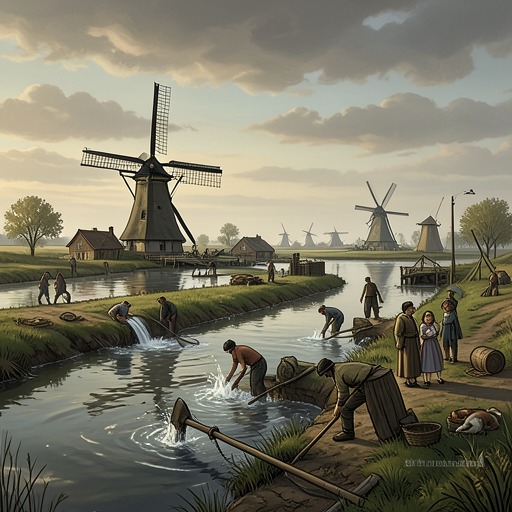
The rising waters spread across Friesland until the province had become an angry sea. People and domestic animals struggled in the flood, while boats and anything that could serve as one were seized for escape. Houses were inundated, and water reached graveyards, carrying the living and the dead together. Survivors gathered on rooftops, trees, and church steeples, calling for help as the storm subsided.
Rescue boats then moved through the flooded country, carrying people from roofs and treetops and helping those still in the water. The account gives the disaster's scale with stark precision: no fewer than 100,000 people died in a few hours. Thousands of animals also perished, and the damage to property was described as beyond calculation. The sequence—from failed defenses, to refuge above the flood, to rescue—makes clear that the crisis did not end when the gale eased; survival depended on reaching those cut off by the water.
Relief and Changes to Dike Governance
Robles, the Spanish governor, took a leading part in efforts to save lives and lessen the disaster's effects. The Dutch had previously disliked him because of his Spanish or Portuguese ancestry, but his actions during the emergency won their gratitude. His response thus altered the account's portrait of him: in a moment of shared peril, practical help outweighed prior hostility.
Afterward, Robles introduced an improved method of dike construction and passed a law requiring landowners to keep the defenses in repair. The book reports fewer severe floods after these changes, though six more disastrous inundations swept the country within less than three centuries. The reform reduced risk without abolishing it. By assigning maintenance to landowners, the law made the security of the wider community depend in part on whether individual owners fulfilled a continuing obligation.
The Continuing Work of Holding Back Water
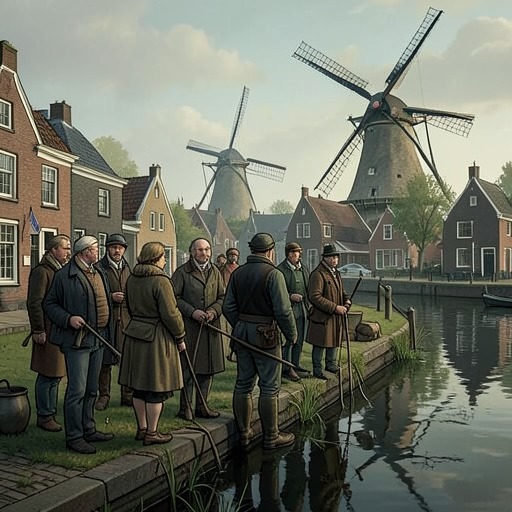
The flood stands within a broader system of water management. Ditches, canals, rivers, lakes, dikes, and sluice gates shape both the landscape and the movement of people through it. Near Halfweg, the Y and Haarlem Lake meet, with the river five feet above the land; the strength of the dikes and sluice gates is therefore essential to preventing flooding. These structures are not isolated barriers but parts of a network that regulates water and makes settlement and travel possible.
The book describes nearly 9,900 large windmills in Holland, their sails ranging from eighty to 120 feet. Though mills serve many kinds of work, their principal purpose is pumping water from lowlands into canals and guarding against inland floods; their annual cost is said to approach ten million dollars. Some newer mills adjust their sails to the available wind, catching light air and yielding to stronger gusts. The machinery embodies an ongoing effort to turn natural forces to the country's defense, but it cannot remove the need for maintenance.
Flood risk also returns seasonally. In spring, thawing rivers can be blocked by ice and overflow before their rising waters can drain to the sea, while the sea continues to press against the dikes. Engineers and workmen keep watch in threatened areas, and residents answer general danger signals by joining the effort. Straw mats, reinforced with clay and heavy stones, are pressed against embankments to resist rushing water. The narrator compares this permanent labor to a prisoner forced to pump against an incoming stream: in Holland, pumping becomes a condition of existence rather than an occasional task.
The same infrastructure reaches directly into family life. Raff Brinker had worked on the dikes for years. During a later threatened inundation, he fell from scaffolding while men labored at a weak point near Veermyk Sluice; afterward, he could no longer work, and his memory and understanding were gone. His accident is not presented as part of the 1570 flood, but it shows how the defense of the country placed workers in danger and how the costs of water management could be borne by individual families. The flood's lasting significance lies in this conjunction: the defenses protect whole communities, yet their construction and repair demand labor, resources, and vigilance without end.